
Why Cracking UPSC Civil Services Is Hard and How to Succeed
Every year, roughly ten lakh people apply for UPSC Civil Services. About a thousand make it through. Do the math and you land somewhere around 0.1%. That’s not a rounded-up scare number for the intro of a blog post it’s just what the numbers actually say, and it’s a big chunk of why UPSC Civil Services has the reputation it does. Talk to anyone who’s actually gone through it and you’ll hear some version of the same line: UPSC Civil Services isn’t hard because of one killer subject. It’s hard because it asks for a year, sometimes more, of effort that doesn’t let up. The syllabus alone is wide enough to eat entire careers of specialization for breakfast.
Most “motivational” articles skip the part that actually matters. Hard doesn’t mean impossible. It also doesn’t mean you need a particular family name, city, or bank balance behind you. So here’s why the exam breaks so many people, and what the ones who actually cleared it did differently.
Is UPSC Tough for Average Students?
Look at the syllabus and the difficulty explains itself. History, polity, economics, geography, ethics, science, current affairs. Mains alone is nine papers. There’s no clever workaround for that much volume, and anyone claiming otherwise is probably trying to sell you a course.
Is it tough for average students specifically, though, or just tough for everyone? That’s really what people are asking when they search this. Here’s the honest answer: your background matters a lot less than most people assume. Take Pradeep Singh, a good example of a first attempt UPSC clear name that actually proves the point. He topped the 2019 exam with AIR 1 on his first try. No family history in the civil services, no big-city coaching machine behind him just a first-generation aspirant from Sonipat who picked Sociology as his optional and figured out the rest on his own.
That’s more or less the whole blueprint for how to start UPSC preparation from zero level. Pick a subject. Build a routine. Stop waiting for the “right” conditions to show up, because they won’t. Toppers come out of engineering colleges, arts colleges, small towns most of us couldn’t point to on a map. What separates the ones who crack it early isn’t talent, and I don’t think it ever really is. It’s whether they built a system and kept showing up to it for the 10 to 14 months the exam demands. Every topper interview eventually says some version of the same thing, and that’s the real upsc topper study strategy hiding underneath all of them: less genius, more discipline, repeated for a very long time.
How to Start UPSC Preparation From Zero Level
If you’re starting from nothing, don’t buy fifteen books in your first week. That’s the classic mistake and almost everyone makes it once.
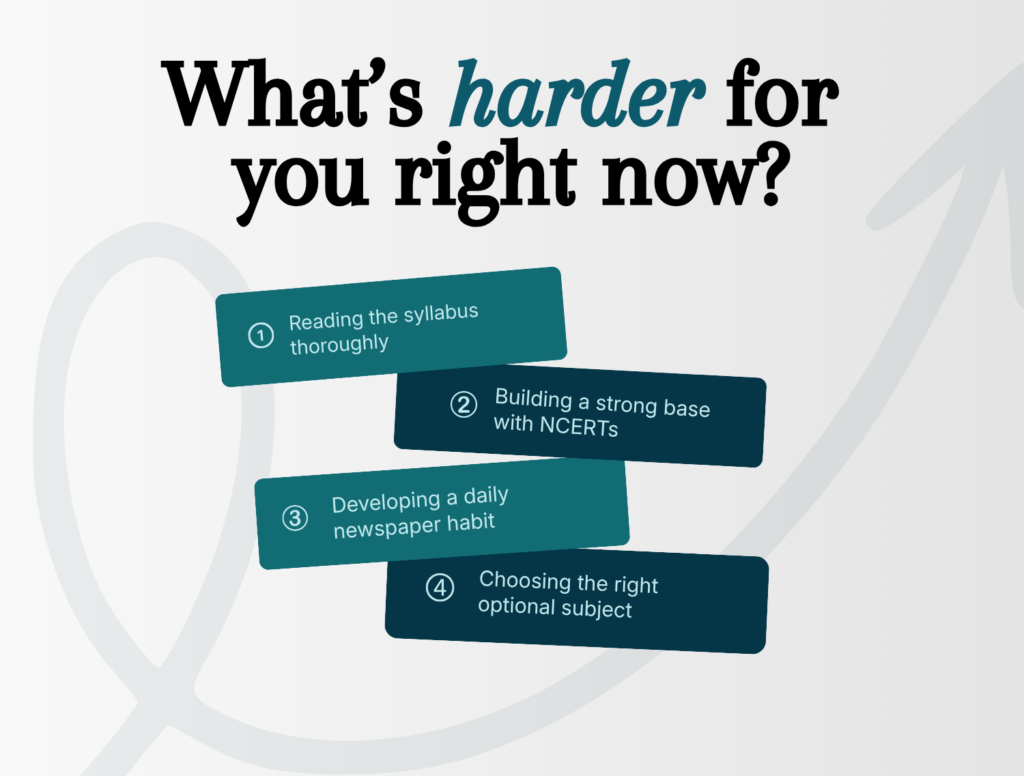
- Start narrower. Read the syllabus like it’s a document you’ll actually be tested on, because you will be. Most aspirants skim it once, feel good about themselves, and never open it again. Print it out. Check things off as you cover them, not before.
- NCERTs, classes 6 through 12, are where the base gets built. Almost every topper mentions this. Not because NCERTs have some magic quality, but because they build the plain-language foundation that every advanced book quietly assumes you already have.
- Newspapers should start today, not “next month.” Current affairs compound. Skip three months and you’re not three months behind, you’re permanently playing catch-up on things you’ll never fully close the gap on.
- Pick your optional subject inside the first six weeks. Don’t let this drag on. Every week you spend undecided is a week you’re not building depth in anything at all.
- Set a Prelims date and work backward from it. Vague timelines produce vague effort, pretty much every time.
The boring, repeatable parts of UPSC Civil Services prep are what separate the people who finish from the people who restart every January with a fresh notebook and the same old plan.
How to Crack the UPSC Exam in Your First Attempt
First-attempt clears aren’t the norm in UPSC Civil Services, but they’re not flukes either; roughly one in ten successful candidates make it on their first go. The ones who pull it off tend to share a few habits, even if they’d never call it a “strategy” out loud:
- They stop treating Prelims and Mains as two separate races. Answer-writing practice starts months before Mains, not the week after Prelims results land.
- They’re stingy about source material. More than one topper has said, almost word for word, don’t hoard books; depth wins over breadth here.
- Mock tests start early, not as a last-month panic move once the date starts feeling close.
- A fixed daily study window matters more than people give it credit for. Studying in unpredictable bursts just doesn’t add up the same way, no matter how many hours you technically log.
If a clear first-attempt in UPSC Civil Services is the goal, discipline beats intelligence almost every time. Plenty of genuinely sharp people take four attempts, and it’s rarely because they weren’t smart enough.
Who Cleared UPSC in Their First Attempt With AIR 1
Only a handful of candidates have ever topped the entire UPSC exam AIR 1, out of more than a million applicants on their very first try. Here’s who they are:
- Tina Dabi (AIR 1, 2015) cleared it at just 22, making her one of the youngest AIR 1 holders in UPSC history.
- Kanishak Kataria (AIR 1, 2018) an IIT Bombay graduate who walked away from a corporate job to prepare full-time, and topped with Mathematics as his optional.
- Ankur Garg (AIR 1, 2002) an engineering graduate from IIT Delhi who secured All India Rank 1 on his very first attempt, also at age 22.
These first-attempt toppers get brought up again and again, and there’s a good reason for it: they prove that cracking AIR 1 on your first try is genuinely possible. But it’s also genuinely rare. Most AIR 1 holders like Aditya Srivastava (2023), Shakti Dubey (2024), and Anuj Agnihotri (2025) needed anywhere from two to five attempts to get there. For most aspirants, that’s the far more realistic path to expect.
Who Cleared UPSC in Their First Attempt Without Coaching
Coaching gives structure, sure but it’s not mandatory, and a few toppers have proven that on the record.
- Srushti Jayant Deshmukh (AIR 5, 2018) cracked it entirely through self-study, relying on online resources and a heavy dose of answer-writing practice instead of a classroom.
- Satyam Gandhi (AIR 10) also went the pure self-study route, coming from Bihar with no formal coaching backing him up.
- Laghima Tiwari (AIR 19, 2022) self-studied for a full year straight after finishing her engineering degree. She picked Anthropology as her optional and even built her own mock test simulations, because nobody else was going to do it for her.
None of this means coaching is bad, it isn’t. It just means a structured self-study plan, built around previous year papers and genuinely consistent revision, can replace it entirely, as long as you’re disciplined enough to hold yourself accountable with no one else doing it for you.
The UPSC Topper Study Strategy That Actually Works
Strip away the individual stories, and a handful of patterns keep showing up across almost every topper’s routine:
- NCERTs come first, advanced material second. This isn’t just beginner advice, toppers return to NCERTs even during their final revision cycle, right before the exam.
- Daily answer writing beats occasional answer writing, no contest. Several toppers mention writing two to three GS answers a day, starting months before Mains, not weeks.
- Fewer sources, revised more heavily, consistently wins over the opposite approach. Four to five full revisions of core material comes up again and again when toppers describe what actually worked.
- Current affairs get woven into the static syllabus, not treated like some separate, floating subject.
If one line captures the whole strategy, it’s this: consistency beats intensity, full stop. Nobody on this list pulled sixteen-hour days for a month before the exam. They studied manageable hours, every single day, for a year or longer. It’s a far less exciting story than the one people want to hear. It’s also true.
UPSC Prelims Preparation Strategy Used by Toppers
Prelims eliminates most candidates before Mains even starts which is exactly why it’s the stage people underprepare for strategically, and it doesn’t get the respect it deserves.
- PYQ-first analysis usually comes first. Solving ten years of previous papers to understand question patterns beats reading a tenth book on the same topic, every time.
- Elimination technique matters just as much as knowing the right answer. Prelims rewards ruling out wrong options almost as much as knowing the correct one and that’s a trainable skill, not something you either have or don’t.
- Full-length mocks under real time pressure show up constantly. We’re talking dozens of them in the final two to three months, not two or three total.
- Most toppers draw a hard line on new material about a month before Prelims, shifting entirely into revision and testing after that point. No new books. No new sources. Just repetition.
Conclusion
Is the UPSC Civil service exam tough for average students? It’s probably the single most-asked question in this whole space, and the honest answer is yes and no at once. It’s difficult. It isn’t impossible. UPSC Civil Services preparation is hard because the exam is built to test sustained effort over a full year or more, not just how sharp you are on exam day. The people who clear it, whichever attempt it took them and whether they went through coaching or not, tend to share one underlying habit. They built a system they could actually live with, and they kept showing up to it long after the initial burst of motivation wore off.
If you’re still deciding whether to join a coaching institute at all, our guide on the Top 10 IAS Academies in India breaks down institutes by mentorship style, teaching approach, and student support. Worth a look before you commit to one.