
The tundra is often seen as an inhospitable and economically marginal region because of extreme cold, permafrost, sparse vegetation and low population density. However, the Arctic tundra and adjoining polar regions possess significant mineral, energy, biological and strategic resources.
At the same time, tundra ecosystems are extremely fragile and recover very slowly from disturbance.
What is the Tundra Region?
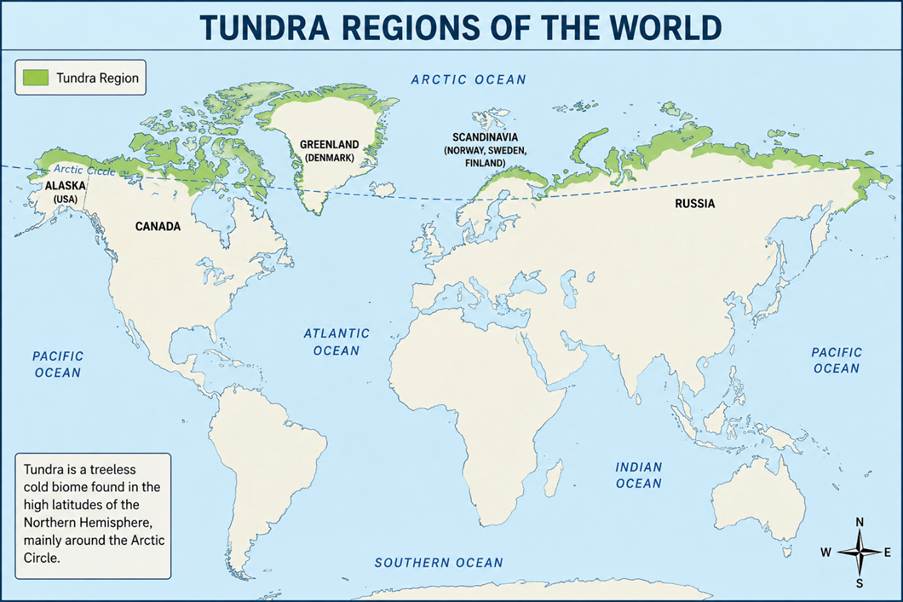
Tundra is a cold, treeless biome found mainly in the high latitudes of Alaska, Canada, Greenland, Scandinavia and Russia.
Economic Significance of the Tundra
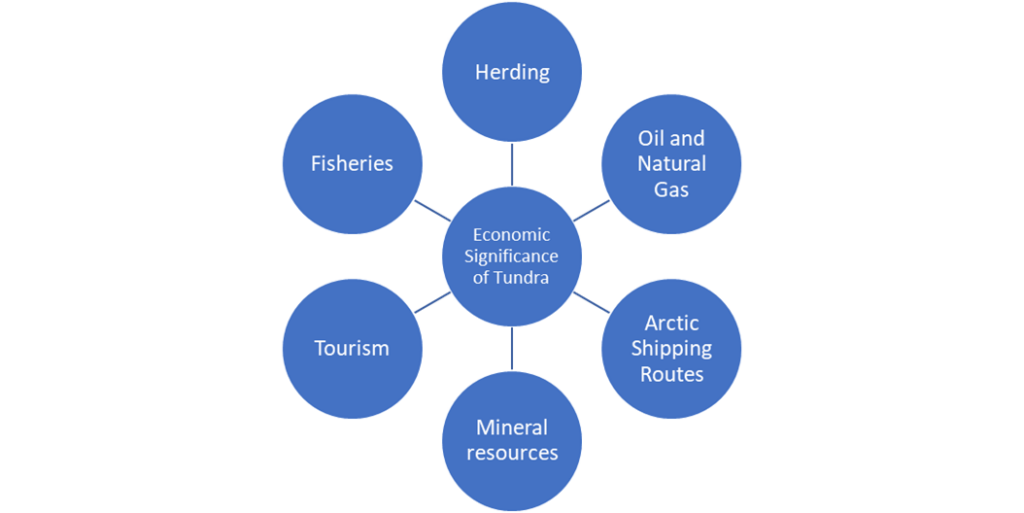
- Reindeer Herding and Traditional Livelihoods
Reindeer and caribou are well adapted to tundra conditions and can survive on lichens and sparse vegetation.
Reindeer herding supports communities such as the Sámi of northern Scandinavia, Nenets of Russia and indigenous communities of Siberia. It provides meat, hides, transport, income and employment.
Similarly, hunting, fishing and gathering remain important sources of food and livelihood for many Arctic communities.
2. Oil and Natural Gas
The wider Arctic region contains considerable hydrocarbon resources.
A US Geological Survey assessment estimated that areas north of the Arctic Circle may contain nearly:
- 13% of the world’s undiscovered oil, and
- 30% of its undiscovered natural gas.
Major areas include:
- North Slope and Prudhoe Bay – Alaska
- Yamal Peninsula and western Siberia – Russia
- Mackenzie Delta – Canada
- Barents Sea region – Norway
Oil and gas development contributes to: energy security + export earnings + employment + infrastructure development
3. Mineral Resources
The tundra and adjoining Arctic regions contain important deposits of:
- nickel;
- copper;
- zinc;
- lead;
- iron ore;
- gold;
- diamonds;
- rare earth elements.
For example, the Red Dog Mine in Alaska is one of the world’s major zinc-producing mines.
With increasing demand for critical minerals required for batteries, renewable-energy technologies and electronics, the strategic importance of Arctic mineral resources is increasing.
4. Fisheries
The seas surrounding the tundra support important fisheries.
Fishing provides both subsistence food and commercial income, particularly in northern Canada, Greenland and Scandinavia.
Hence, the economic geography of tundra regions is closely linked with the surrounding Arctic marine ecosystem.
5. Tourism
The tundra’s unique environment supports specialised tourism such as Aurora Borealis tourism, wildlife viewing, Arctic cruises, trekking, indigenous cultural tourism and adventure tourism.
Tourism creates opportunities for local employment in transport, accommodation, guiding and handicrafts.
6. Emerging Arctic Shipping Routes
Reduction in seasonal sea-ice cover has increased interest in Arctic navigation.
Important routes include:
- Northern Sea Route along the Russian coast;
- Northwest Passage through the Canadian Arctic.
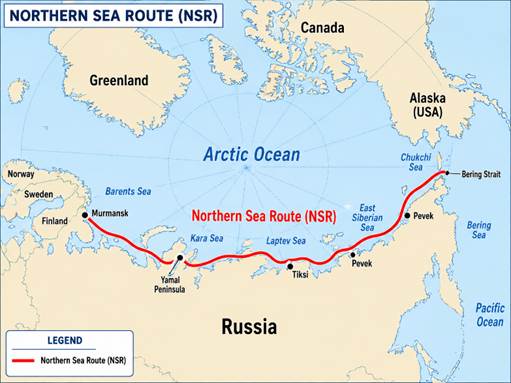
These routes may reduce sailing distance between parts of Europe and Asia.
Greater accessibility also encourages:
ports → logistics → resource extraction → infrastructure development
Thus, Arctic warming is increasing the strategic and economic importance of the tundra margins.
Why is the Tundra Ecologically Fragile?
Economic exploitation is constrained by the tundra’s very low ecological resilience.
1. Slow Recovery
Because of the short growing season and low temperatures, damaged vegetation may take decades to regenerate.
2. Permafrost Disturbance
Roads, pipelines, mining and buildings can accelerate permafrost thaw, causing:
ground subsidence → thermokarst → infrastructure damage
3. Pollution
Oil spills and mining contamination are particularly damaging because decomposition and ecological recovery are very slow.
4. Threat to Traditional Livelihoods
Mining, pipelines and roads can disrupt:
- reindeer migration routes;
- grazing grounds;
- hunting areas;
- fishing resources.
Climate Change: Opportunity and Threat
Climate change has created a major contradiction in tundra regions.
Economic opportunities
- longer navigation season;
- easier access to minerals;
- expansion of tourism;
- greater accessibility of Arctic resources.
Ecological and economic risks
- permafrost thaw;
- infrastructure damage;
- coastal erosion;
- altered reindeer grazing;
- carbon and methane release;
- ecosystem degradation.
The tundra is no longer an economically peripheral region. Its hydrocarbon reserves, minerals, fisheries, traditional livelihoods, tourism potential and emerging transport routes give it considerable economic importance.
However, its low biological productivity, permafrost dependence and slow ecological recovery make it exceptionally fragile.
Therefore, tundra regions should be viewed as high-value but low-resilience landscapes, where economic development must remain within strict ecological limits.